


jakafe
Kenya - Kiangoi AA - Washed
Kenya - Kiangoi AA - Washed
In stock
Prices are listed per 1kg excluding VAT and are subject to final approval.
GrainPro 60 kg packaging
🏞️ Region and Terroir
Kenya Kiangoi AA comes from the Kirinyaga region, one of the most important coffee-producing areas in central Kenya. Kirinyaga is located on the slopes of the majestic Mount Kenya, Africa's second-highest mountain.
The local coffee trees grow at high altitudes, approximately between 1,600 and 1,800 meters, in a landscape characterized by cooler nights, abundant rainfall, and fertile volcanic soils. It is the combination of altitude, climate, and volcanic subsoil that allows for the slow ripening of coffee cherries and promotes a high concentration of sugars and aromatic compounds. Trabocca describes Kirinyaga as one of Kenya's key regions where these conditions create coffees with pronounced acidity, structure, and clarity.
The Kiangoi terroir is typically Kenyan: red to dark volcanic soils, high altitude, regular rainfall, and significant differences between day and night temperatures.
The result is dense beans with a very intense aromatic potential, which, after precise washed processing, can offer pronounced fruitiness and brilliant acidity.
🌋 Kirinyaga and Mount Kenya
The name Kirinyaga is historically linked to Mount Kenya. The region is primarily home to the Kikuyu community, for whom the mountain holds significant cultural and spiritual importance.
Kirinyaga is among the regions where coffee production is primarily based on small family farms. Farmers often cultivate plots smaller than one hectare and combine coffee trees with other crops, such as bananas, avocados, or macadamias.
This system of small farms creates a mosaic of different microclimates and also allows farmers to diversify their livelihoods. Trabocca states that the central Kenyan regions around Mount Kenya are among the most significant sources of high-quality specialty coffee.
👨🌾 Kiangoi Factory and Rung’eto Farmers Cooperative Society
Kiangoi is not a classic large coffee farm. In the Kenyan system, a "factory" refers to a processing station where small farmers bring their freshly harvested cherries.
Kiangoi is part of the Rung’eto Farmers Cooperative Society, a cooperative that also includes other well-known processing stations Kii and Karimikui. Rung’eto was formed by merging several original cooperatives and gradually developed into a significant producer of quality coffee in Kirinyaga.
Small-scale producers, who mostly manage small coffee gardens, deliver coffee to Kiangoi. Their manual labor and selective harvesting are the foundation of the resulting lot's quality.
At Kiangoi, mainly SL28, SL34, and Ruiru 11 varieties are traditionally grown. The older Kenyan varieties SL28 and SL34 are renowned for their high cup quality and pronounced fruitiness, while Ruiru 11 is a more modern variety bred with disease resistance in mind, among other factors.
🌱 Varieties
SL28
One of Kenya's iconic varieties. Its high cup quality potential often manifests as notes of red and black fruits, pronounced acidity, and complexity.
SL34
A variety well adapted to high-altitude conditions. In the cup, it contributes to sweetness, body, and fruity complexity.
Ruiru 11
A more modern Kenyan variety bred at the Coffee Research Station in Ruiru. It was developed to combine good productivity and resistance to major diseases.
⚙️ Traditional Kenyan Washed Processing
Kiangoi uses the classic Kenyan Fully Washed process, which is one of the main reasons for the characteristic profile of Kenyan coffees.
Selective Harvesting
Farmers hand-pick only ripe, red cherries. These are then delivered to the station on the same day of harvest to minimize undesirable fermentation before processing.
Sorting and Flotation
Upon reception, the cherries are sorted to remove unripe, overripe, or damaged fruits and other impurities.
Pulping
The cherries pass through a mechanical pulper, which removes the skin and most of the pulp. The parchment coffee is then sorted by density.
Fermentation
The parchment, with its mucilage layer intact, then ferments. In the Kenyan process, fermentation is essential for removing residual pulp and creating a clean and clear flavor profile.
Washing and Soaking
After fermentation, the coffee is thoroughly washed with clean water. This is followed by soaking, which helps remove residual mucilage and contributes to the typical cleanliness, brilliant acidity, and transparency of the Kenyan cup.
Drying
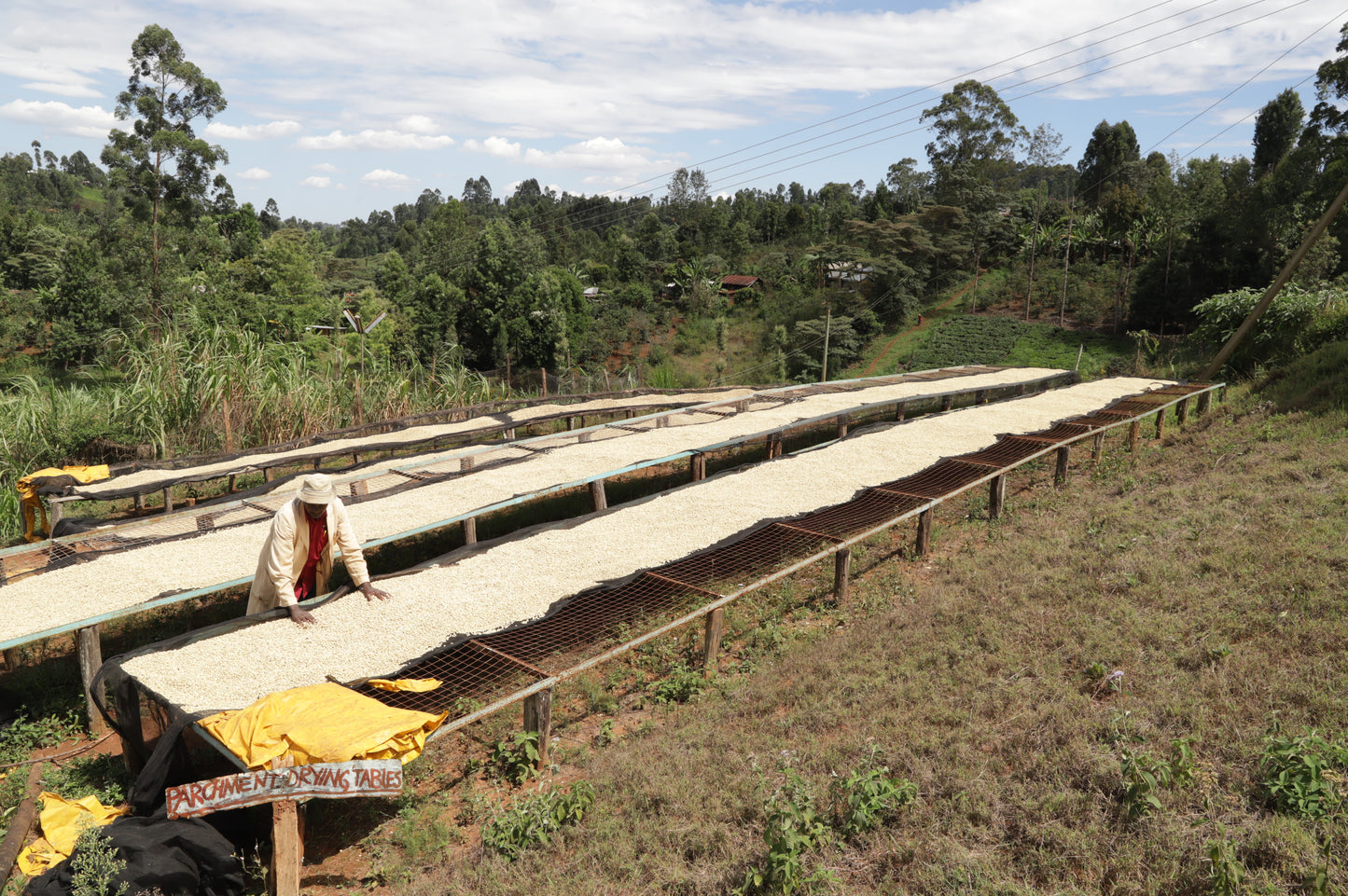
The washed parchment is then spread on raised African beds, where it slowly dries in the sun. The coffee is regularly turned to ensure even drying.
After drying, the parchment rests and stabilizes, followed by dry processing, sorting by size and density, and preparation of the export lot.
🏷️ What does AA mean?
The designation AA does not describe flavor or cupping score, but bean size.
AA represents one of the largest grades of Kenyan coffee beans. In the Kenyan system, beans are sorted primarily by size using screens. A large bean does not automatically mean a better flavor, but in combination with quality terroir and precise processing,
Flavor Profile: Red currant, lemon, orange, black tea, hibiscus
Country of Origin: Kenya
Region: Kirinyaga
Washing Station: Kiangoi Coffee Factory
Farmer: Smallholder farmers delivering to Kiangoi
Altitude: 1600-1800 m.a.s.l.
Variety: SL28, SL34, Ruiru
Processing: Washed
Cupping Score: 87
Crop: 2025/2026


Ask for quantity and price
Please also include the specific product you are interested in in the text.